Mathweave · One evening, in order
Primary maths lessons, practice and progress
One evening, in order. Your child watches a lesson, practises the same question type, sees the common mistake explained when they make it, and you see what still needs work.
7 days free. No card is required.
Step 1 · Watch
Watch a primary maths lesson
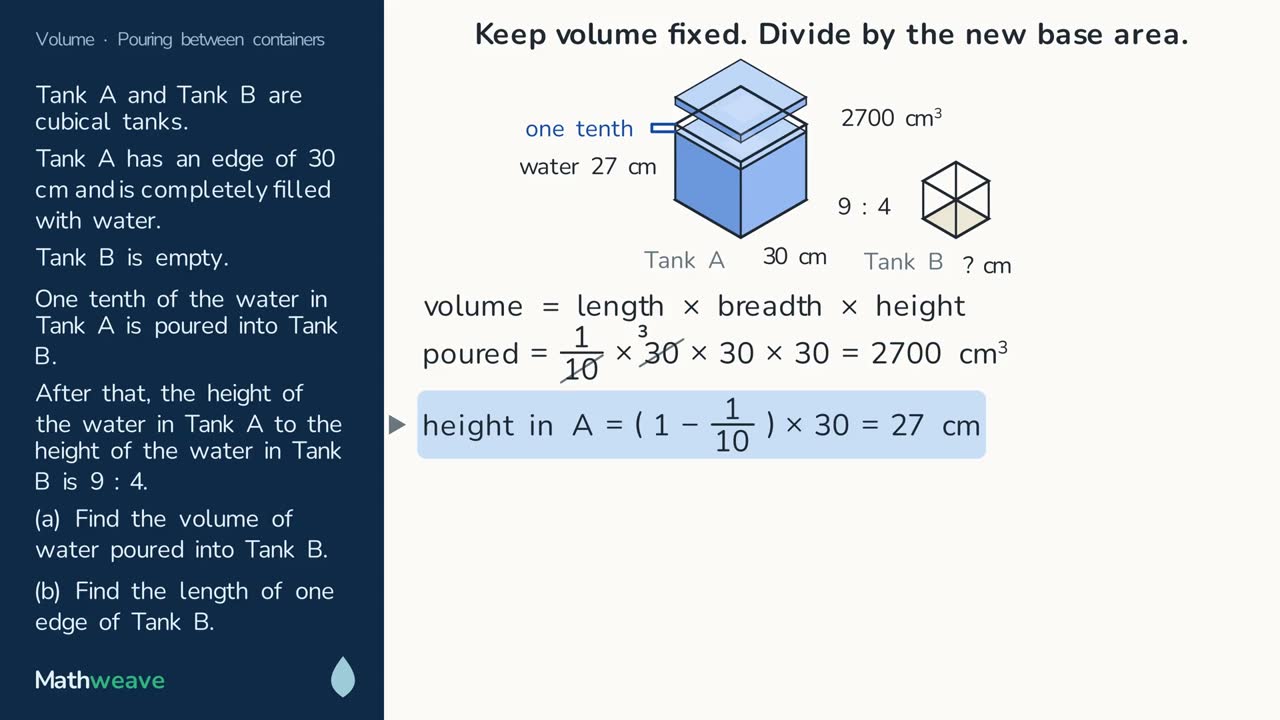
Every question type has its own lesson. The figure is drawn first, then the working lands one line at a time while a teacher's voice says why that line is needed. Everything already written stays on screen, so your child never has to hold an earlier step in their head.
Step 2 · Practise
Practise one PSLE maths question type
After the lesson, your child practises the same question type and nothing else: easy questions first, then harder ones, then exam style. Every practice question comes with its own solution taught on screen, drawn and explained the way the lesson was. In Ratio, the numbers change each time; other chapters use their authored questions.
Depth · One question type, all the way up
PSLE maths practice from easy to exam style
These eight Ratio questions show the full progression, from a direct calculation to mixed concepts, an unfamiliar challenge and a Paper 2 question.
Basic
Read one share straight from the unit.
Priya and Samuel share 45 beads in the ratio 2 : 3. How many beads does Samuel get?
Intermediate
The whole is not given. You work back to it from one share.
A prize is shared between Wei Jie and Hui Min in the ratio 4 : 5. Wei Jie receives $28. How much is the prize altogether?
All concepts combined
The chapter's question types come back together, and nothing tells you which is which.
The number of marbles Chloe and Marcus had was in the ratio 7 : 3. Chloe then gave Marcus 24 marbles, and they had the same number each. How many marbles did Chloe have at first?
The ratio of comic books to storybooks on a shelf was 2 : 5. After 18 more comic books were added, the ratio became 4 : 5. How many storybooks are on the shelf?
The number of Adam's bottle caps to Grace's is in the ratio 3 : 5. What fraction of all the caps are Adam's?
More than one concept
One question combines two question types. Identifying both is part of the skill, so neither is labelled.
A bakery sold 630 loaves and rolls altogether one morning. The number of loaves to the number of rolls was 4 : 5. Loaves are sold in packs of 7 for $9 and rolls are sold in packs of 5 for $14. How much money did the bakery take that morning?
Harder questions
A harder question: the ratio counts boxes, the total counts tiles, and the divisor is not given.
In a store, the number of large boxes to the number of small boxes is 2 : 3. Each large box holds 10 tiles and each small box holds 5 tiles. There are 210 tiles altogether. How many small boxes are there?
Exam-style questions
Children practise choosing and setting out the methods needed for multi-step Paper 2 questions that combine question types. Worked solutions show how to set out the method.
A shop stocked plain T-shirts and printed T-shirts. 25% of the T-shirts were printed. The shop then sold 30 printed T-shirts and 30 plain T-shirts. After that, 20% of the T-shirts left were printed. How many T-shirts did the shop stock at first?
Step 3 · The mistake
PSLE maths practice: the common mistake explained
When an answer matches a recognised common mistake, the page names it and explains the step to revisit. Your child can return to the worked solution before trying again.
Illustrative feedback for the fruits question above.
1 unit = 24 ÷ 2 = 12
Ans: 12 Common mistake
12 is one unit. We need the original 4 units: 4 × 12 = 48 fruits.
Step 4 · Afterwards
Primary maths progress by question type
You do not have to sit through each session. Afterwards, the progress view shows which question types your child gets wrong most often, when each was last practised, and what comes first in revision. The next evening, you have a specific place to start.
Illustrative progress view, not a real child’s results.
Needs work
These are the question types your child gets wrong most often. They come first in revision.
- The difference stays the same3 out of the last 6 wrong · last practised 11 days agoRatio
- Fraction of the remainder2 out of the last 6 wrong · last practised 4 days agoFractions
The plan · What it adds
Primary maths lessons and the practice plan
The lesson films and the sample questions are open to watch. Primary 6 is available now, with a film and practice for every question type. Primary 3 to Primary 5 are not available yet. You can ask to be told when they are.
The paid plan adds the practice around them: original questions, full worked solutions and progress for each question type. Ratio practice can generate fresh sets of numbers. It is S$39 a month or S$390 a year, for one child.
Start your free trial7 days free. No card is required. See plans and prices