Common PSLE Maths Question Types: How to Recognise the Pattern and Choose a Method
Name the quantities, identify their relationship and choose a first move. Six short cases help you see why a method fits before you start calculating.
On this page
You may know how to draw a model or calculate a fraction and still feel unsure where to start a word problem. The missing step is often recognising the relationship: what is being compared, what changes, and which amount a fraction or ratio describes. A familiar story does not always need a familiar method.
This guide helps you choose a useful first move through six short, original examples and a mixed check. It draws on skills across upper primary maths; the formal ratio and average connections are for P6. The aim is to explain why a method fits, then follow the relevant lesson when you need more practice.
Ask three questions before calculating
- What must my answer describe? Write the noun and unit: coins, pairs, dollars, centimetres or square centimetres.
- What does each clue refer to? Label the whole in a fraction, the order in a ratio and the stage in a before-and-after story.
- What relationship connects the clues? Look for a fixed total, equal amounts, a repeated group or a shared region.
Then choose a representation that makes that relationship visible. A bar model can show equal parts. A table can keep a count fixed while you try combinations. A labelled sketch can show that two apparently different regions include the same piece.
| Relationship in the question | First move to try |
|---|---|
| A fraction of what remains | Find and label the new whole. |
| Fractions of different quantities are equal | Represent the equal amount before comparing the wholes. |
| Quantities change between two stages | Identify what the action preserves. |
| A fixed count contains two differently valued kinds | Keep the count fixed while comparing replacements. |
| Two regions contain the same overlap | Check whether the shared part cancels in their difference. |
| Groups have different sizes and averages | Recover their totals before combining them. |
Why one keyword cannot choose your method
“More” can describe a given amount or the answer you must find. “Left” can refer to a remainder or a position in a diagram. “Equal” is incomplete until you identify what is equal.
For example, “six more than 18” gives 18 + 6 = 24. “Three times as many as 18” gives 18 × 3 = 54. Both compare two quantities, but they express different relationships. Underline the complete phrase, not just a single word. The same care is needed when a question says “equal numbers of coins” rather than “equal amounts of money”.
1. A fraction can refer to a new whole
A craft club has 84 tokens. It uses one third of them, then gives away one quarter of the remaining tokens. How many tokens does it give away?
First move: identify the whole used by the second fraction. It is the remainder, not 84.
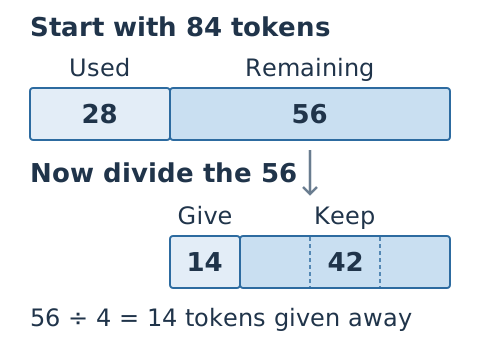
Used = 84 ÷ 3 = 28 tokens
Remaining = 84 − 28 = 56 tokens
Given away = 56 ÷ 4 = 14 tokens
Check: 28 used + 14 given away + 42 kept = 84 tokens.
If the wording instead said “one quarter of the original tokens”, the amount given away would be 84 ÷ 4 = 21. The numbers and story can stay almost the same while one phrase changes the calculation.
Compare the two interpretations in fraction of the remainder or total. For the complete procedure, use the fraction-of-remainder lesson.
2. Equal parts need not come from equal wholes
Two fifths of Mei’s ribbon and three quarters of Bala’s ribbon are each 24 cm. How long is each complete ribbon?
First move: keep the shared 24 cm separate from the two complete ribbons.
One fifth of Mei’s ribbon = 24 ÷ 2 = 12 cm
Mei’s ribbon = 12 × 5 = 60 cm
One quarter of Bala’s ribbon = 24 ÷ 3 = 8 cm
Bala’s ribbon = 8 × 4 = 32 cm
Mei needs five parts of 12 cm; Bala needs four parts of 8 cm. Calling both “one part” without their owners would hide that difference. Check by finding two fifths of 60 and three quarters of 32: both are 24.
The P5 equal-fractions lesson shows how to represent the shared amount when the full quantities are unknown.
3. The same number can describe different changes
Two trays hold 48 and 30 counters. Compare two separate situations: six counters move from the first tray to the second; or six counters are removed from each tray.
First move: describe the action before deciding what stays fixed.
| Action | New amounts | What stays fixed? |
|---|---|---|
| Transfer six | 48 − 6 = 42; 30 + 6 = 36 | Total: 78 before and after |
| Remove six from each | 48 − 6 = 42; 30 − 6 = 24 | Difference: 18 before and after |
In the transfer, the difference falls from 18 to 6 because one tray loses while the other gains. With equal removals, the total falls from 78 to 66. Neither action preserves everything.
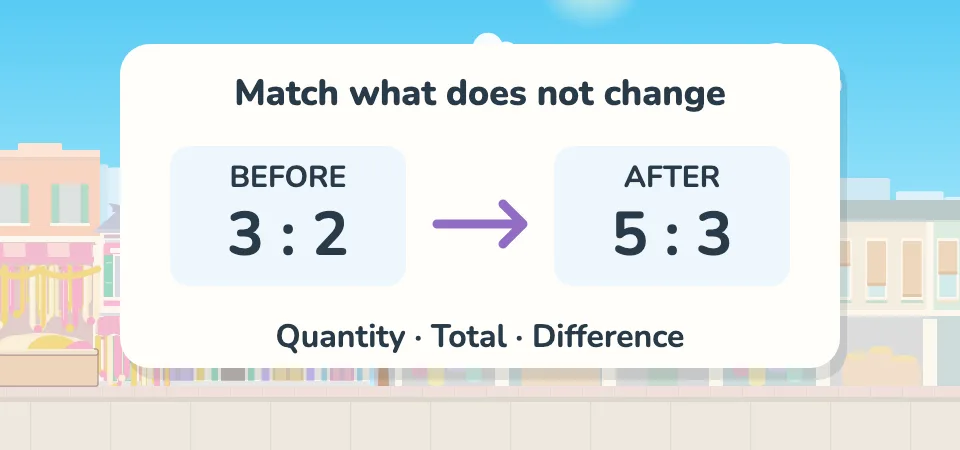
For P6 ratio questions, this decision tells you which terms to match before comparing units. The before-and-after ratio guide develops three original problems where the starting amounts are unknown. Do not automatically carry one ratio’s unit into the next ratio.
4. Keep the count separate from the combined value
Eleven activity tickets cost $56 altogether. A basic ticket costs $4 and an extended ticket costs $7. How many extended tickets were bought?
First move: preserve eleven tickets while changing their kinds.
Cost of eleven basic tickets = 11 × $4 = $44
Extra cost needed = $56 − $44 = $12
Extra cost per replacement = $7 − $4 = $3
Extended tickets = $12 ÷ $3 = 4
Check: four extended and seven basic tickets give eleven tickets and $28 + $28 = $56. Their money contributions are equal, even though their counts are not.
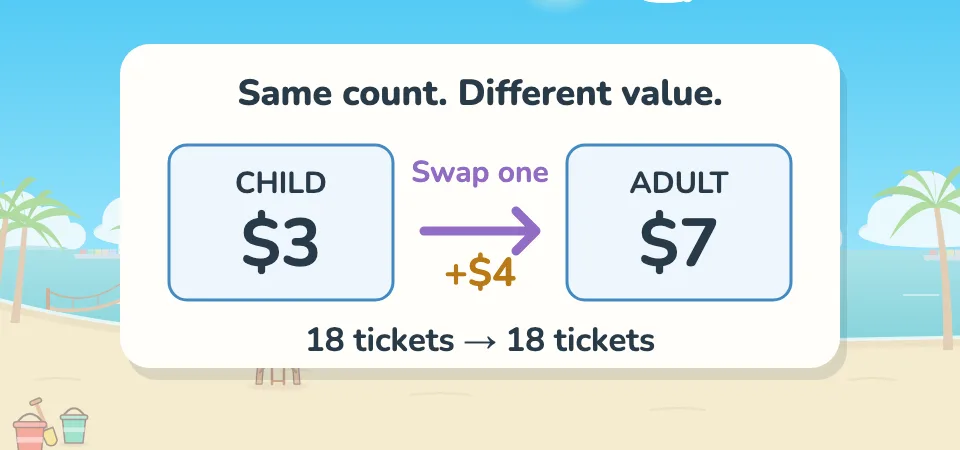
A systematic trial table can reach the same answer. Read guess and check versus assumption to compare those routes. A money story does not automatically require ratio notation.
5. A shared region may cancel in a comparison
Two shapes have areas of 18 cm² and 14 cm². Their overlap is 6 cm². How much larger is the first shape’s non-overlapping region than the second’s?
First move: notice that both non-overlapping regions exclude the same 6 cm².
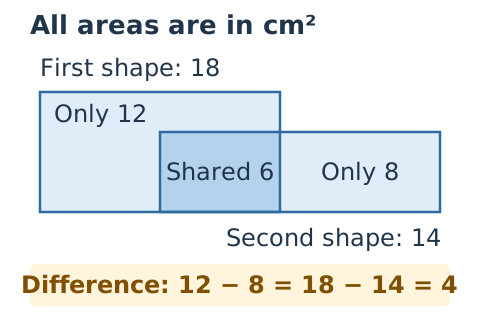
First exclusive area = 18 − 6 = 12 cm²
Second exclusive area = 14 − 6 = 8 cm²
Difference = 12 − 8 = 4 cm²
The shorter route is 18 − 14 = 4 cm²: subtracting the same overlap from both changes neither gap. That conclusion depends on asking for a difference. Finding the total covered area instead would require 18 + 14 − 6 = 26 cm², so that the overlap is counted once.
Continue with the two-shapes overlap lesson for further diagram work.
6. An average belongs to a particular group
Four boxes contain an average of seven pencils each. Two other boxes contain an average of thirteen pencils each. What is the average across all six boxes?
First move, P6: recover each group’s total. The groups have different numbers of boxes.
First group total = 4 × 7 = 28 pencils
Second group total = 2 × 13 = 26 pencils
Combined total = 28 + 26 = 54 pencils
Combined average = 54 ÷ 6 = 9 pencils
Calculating (7 + 13) ÷ 2 = 10 gives equal weight to two unequal-sized groups. The original question gives more boxes to the group with the lower average.
The P6 average lesson connects count, total and average. Name all three before combining information.
Choose a first move without a label
These questions use fresh numbers. For each, write one sentence explaining your first move, then solve it. Do not choose a method just because its example was nearby.
- A club has 96 badges. It gives away one quarter, then packs one third of the remainder into gift bags. How many badges go into the bags?
- Twelve notebooks cost $60 altogether. Small notebooks cost $3 each and large notebooks cost $7 each. How many large notebooks were bought?
- Two overlapping shapes have areas of 23 cm² and 17 cm². Their overlap is 8 cm². Find the difference between their non-overlapping areas.
- A bag holds 20 red and blue counters. There are more red counters than blue counters. Can you find the exact number of red counters?
Check your reasoning and answers
1. The second fraction uses the remainder: 96 ÷ 4 = 24 given away; 96 − 24 = 72 remain; 72 ÷ 3 = 24 badges packed.
2. Keep twelve notebooks fixed. All small would cost 12 × $3 = $36. The extra $24 requires $4 per replacement, so there are 6 large notebooks. Six of each cost $42 + $18 = $60.
3. Both exclusive regions exclude the same overlap. Their difference is 23 − 17 = 6 cm². Direct check: 15 − 9 = 6.
4. There is not enough information. Twelve red and eight blue fit, but fifteen red and five blue also fit. Two valid possibilities give different answers.
Choose the next lesson from your explanation
If you could calculate but could not explain the first move, revisit the relationship rather than repeat more arithmetic. Use a linked method lesson for deeper practice. To see how a familiar skill connects to a new idea, the P4-to-P5 connecting-steps article follows three problems from foundation to final answer.
These examples organise useful relationships, not an exhaustive list of PSLE question types or a forecast of a future paper. Longer questions may combine them. The habit to carry forward is specific: name the quantities, identify the connecting relationship, and check the answer against every original clue.
Practise this with your child
 Primary 6 · FractionsFraction of the remainder
 Primary 5 · Four Operations of FractionsEqual fractions of two wholes
 Primary 6 · AverageLevel the bars
Lesson films and practice with worked solutions. Question 1 of every set is free.
Start the free trialKeep learning
 P4–P5
Helping at home
Why P5 Maths Feels Harder: Connecting the Steps in Questions
Connect familiar skills to mixed numbers, discounts and triangle area.
· 7 min read
 P6
Problem-solving
Before-and-After Ratio Problems: How to Tell What Stays the Same
Choose the unchanged quantity, total or difference before calculating.
· 10 min read
 P3–P6
Problem-solving
Guess and Check or Assumption Method? How to Choose
Two methods, one problem. Understand what each replacement changes.
· 7 min read
About these questions
These are original Mathweave questions, written for this article and informed by our research into Singapore primary-school problem structures. They are practice questions, not reproduced school questions or predictions of a future paper.