Before-and-After Ratio Problems: How to Tell What Stays the Same
Three original problems show how to match an unchanged quantity, total or difference. Try three more with checked answers.
On this page
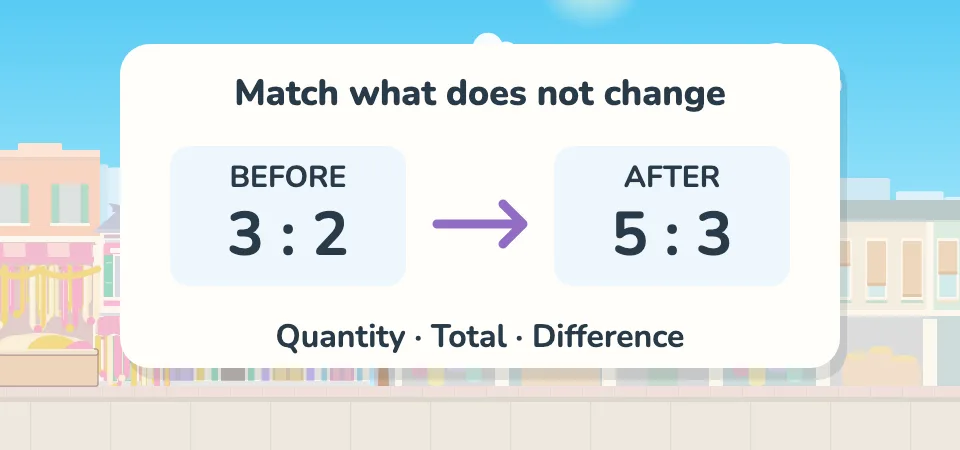
A before-and-after ratio question can be difficult even when you know how to simplify ratios. The ratios describe relative amounts at different times, so one unit in the first ratio need not represent the same actual amount as one unit in the second. Subtracting the terms immediately can compare unequal units.
This article teaches you to choose what to match before calculating: an unchanged quantity, total or difference. Three original problems show how the action determines that choice. You will learn why the units can be compared, what changes when the story changes, and how to check your chosen method against the original conditions.
Why matching an unchanged amount works
The same actual amount, divided into the same number of equal parts, gives equal-sized units. That is the reason for rescaling the ratios.
- One quantity fixed: make its corresponding terms equal.
- Total fixed: make the sums of the terms equal.
- Nonzero difference fixed: make the gaps between the terms equal.
First justify what is unchanged from the story. Then match it in the ratios. An unchanged ratio by itself does not mean unchanged amounts: both quantities could have doubled. If the difference is zero, equality alone cannot determine the amounts; use another clue.
Only one quantity changes
An art club has circular stickers and star-shaped stickers in the ratio 3 : 2. It receives 18 more circular stickers. The number of star-shaped stickers does not change. The new ratio of circular stickers to star-shaped stickers is 5 : 3.
How many stickers did the club have at first?
The deciding clue: the star-shaped stickers are unchanged. Their ratio term must represent the same amount in both rows.
See the model and full working
Match the unchanged star stickers
Multiply both terms by 3: 3 : 2 → 9 : 6
Multiply both terms by 2: 5 : 3 → 10 : 6
Each block is one matched unit, u. The purple block is the extra 1u of circular stickers.
Star stickers: 6u before = 6u after
- Match the star terms: 2 and 3.Use 6 as the common term. The ratios become 9 : 6 and 10 : 6. Now let u be one of these matched units.
- Use the increase of 18 stickers.Increase = 10u − 9u = 1u1u = 18 stickers
- Find the original total.Original total = 9u + 6u = 15u15 × 18 = 270 stickers
Answer: 270 stickers at first.
Why can’t I subtract 5 − 3 straight away?
Those terms come from ratios with different-sized units. The unchanged star count is represented by 2 in one ratio and 3 in the other. Match those terms first; only then can the circular-sticker terms be compared.
The first question keeps one holding fixed. A transfer changes both holdings, so following one holding is no longer enough. Look at what happens to the pair.
A fraction moves between two quantities
A camp stores reusable cups at Stations A and B in the ratio 3 : 2. Volunteers move one quarter of the cups originally at A to B. No cups are added or removed elsewhere. Afterwards, B has 14 more cups than A.
(a) How many cups were moved?
(b) How many cups are at the two stations altogether?
The deciding clue: every cup leaving A arrives at B. The total stays fixed, even though the larger collection changes sides.
See the model and full working
Make the quarter visible
Multiply both terms by 4: 3 : 2 → 12 : 8
¼ of 12u = 3u to move
Each block is one unit, u. The same 3 purple units leave A and arrive at B.
Total: 12u + 8u = 9u + 11u = 20u
- Scale 3 : 2 to 12 : 8.One quarter of A is now 3 whole units. Move those same 3u: A has 9u and B has 11u.
- Use the final difference.Final gap = 11u − 9u = 2u1u = 14 ÷ 2 = 7 cups
- Find the amount moved.3 × 7 = 21 cups
- Use the unchanged total.Total = 12u + 8u = 20u20 × 7 = 140 cups
Answers: (a) 21 cups (b) 140 cups.
Why isn’t the transfer one quarter of all the cups?
The fraction refers to A’s original holding, not the combined collection. On the model, it is ¼ of 12u, not ¼ of 20u. Also, B gains what A loses; the transfer does not keep their difference fixed.
In a transfer, the items stay inside the pair. In the next question, money leaves both people. Equal spending preserves their gap even while their combined savings fall.
Both spend an equal amount
Siti and Bala have savings in the ratio 5 : 3. They each buy one science kit at the same price, spending $72 altogether. The ratio of Siti’s remaining savings to Bala’s remaining savings is 7 : 3.
How much money did Siti have at first?
The deciding clue: both lose the same number of dollars. Their difference stays fixed. The $72 is their combined spending.
See the model and full working
Match the difference, not the total
Before gap: 5 − 3 = 2 ratio units
After gap: 7 − 3 = 4 ratio units
Double both terms: 5 : 3 → 10 : 6
Each block is one matched unit, u. Hatched blocks show the equal 3u spent by each person; they are no longer in the remaining amount.
Difference: 10u − 6u = 7u − 3u = 4u
- Find each person’s spending.$72 ÷ 2 = $36
- Match the difference at 4u.Write the before ratio as 10 : 6. Keep the after ratio at 7 : 3. Let u be one matched unit.
- Connect the decrease to $36.Siti’s decrease = 10u − 7u = 3u1u = $36 ÷ 3 = $12
- Find Siti’s original amount.10 × $12 = $120
Answer: Siti had $120 at first.
Why can’t we keep the total fixed?
The kits cost $72 altogether, so that money leaves the pair. Their total falls by $72. Equal spending preserves the difference, not the total. Using $72 as each person’s spending would also double the amount removed.
What if neither action fits?
Two trays hold 40 and 24 plant tags. Half the tags in the first tray and one quarter of those in the second are used. What is the new ratio?
Check the actual changes: the trays lose 20 and 6 tags. These are unequal removals, so do not assume a fixed difference.
| Tray | Before | After |
|---|---|---|
| First | 40 | 40 − 20 = 20 |
| Second | 24 | 24 − 6 = 18 |
New ratio: 20 : 18 = 10 : 9. Total: 64 → 38. Difference: 16 → 2. Neither quantity, the total nor the difference is unchanged.
Now choose the method yourself
For each question, write what stays the same before calculating. All three are original Mathweave questions.
Try A
A games box has yellow and blue tokens in the ratio 2 : 5. After 18 yellow tokens are added, with no change to the blue tokens, the ratio becomes 4 : 7.
How many blue tokens are there?
Check the method and answer
Keep the blue count fixed. Match its terms at 35: 2 : 5 → 14 : 35; 4 : 7 → 20 : 35.
Increase = 20u − 14u = 6u.
1u = 18 ÷ 6 = 3 tokens.
Blue tokens = 35 × 3 = 105.
Check: 42 : 105 = 2 : 5; after adding 18, 60 : 105 = 4 : 7.
Try B
Tubs A and B contain mosaic tiles in the ratio 5 : 3. Eighteen tiles are moved from A to B. Nothing enters or leaves the two tubs. Their new ratio is 1 : 1.
How many tiles are there altogether?
Check the method and answer
Keep the total fixed. The original total is 8 ratio units. Write 1 : 1 as 4 : 4, also totalling 8.
A loses 5u − 4u = 1u.
1u = 18 tiles.
Total = 8 × 18 = 144 tiles.
Check: 90 and 54 become 72 each after 18 move from A to B.
Try C
Mei and Ravi have money in the ratio 7 : 4. They each receive $18. The new ratio of Mei’s money to Ravi’s money is 3 : 2.
How much did Mei have at first?
Check the method and answer
Keep the difference fixed. The original gap is 3 units. Write the final 3 : 2 as 9 : 6, whose gap is also 3.
Increase = 9u − 7u = 2u.
1u = $18 ÷ 2 = $9.
Mei originally had 7 × $9 = $63.
Check: $63 : $36 = 7 : 4. Adding $18 to each gives $81 : $54 = 3 : 2.
The sentence to write before solving
“The ___ stays the same because ___.” Use the action to fill the blanks. Match that quantity, total or difference in the ratios. If none is fixed, track the separate changes.
For a wider choice of methods, use the PSLE question-type map. For chapter revision, return to the P6 ratio study guide.
Practise this with your child
 Primary 6 · RatioOne quantity stays the samePrimary 6 · RatioThe total stays the samePrimary 6 · RatioThe difference stays the same
Lesson films and practice with worked solutions. Question 1 of every set is free.
Start the free trialKeep learning
 P5–P6
Problem-solving
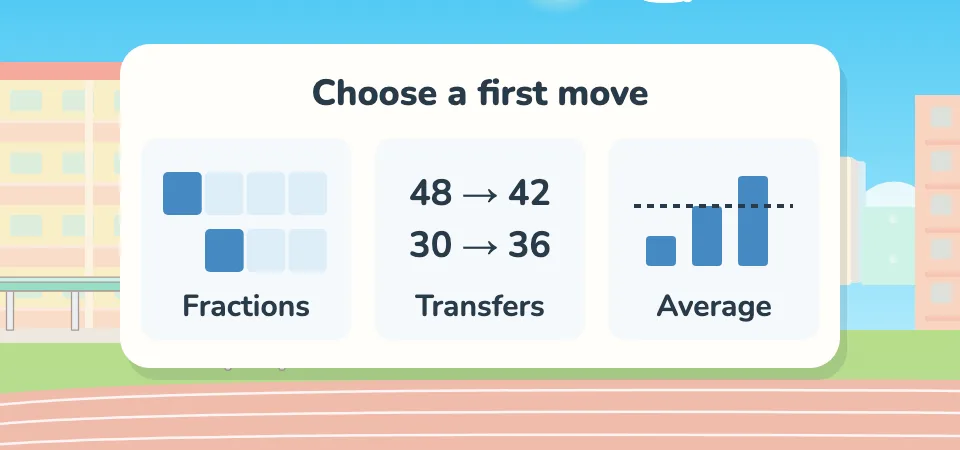
Common PSLE Maths Question Types: How to Recognise the Pattern and Choose a Method
See the relationship in a problem and choose a first move.
· 9 min read
 P4–P6
Problem-solving
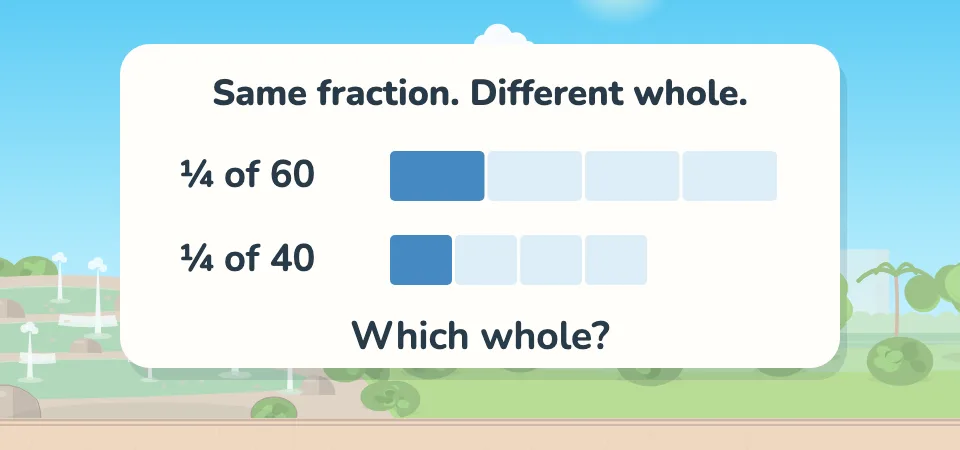
Fraction of the Remainder or Fraction of the Total? How to Tell Them Apart
Almost the same words can change which whole you need.
· 6 min read
About these questions
These are original Mathweave questions, informed by our research into Singapore primary-school examination problem structures. The scenarios, numerical data and worked explanations were written for this article. They are practice questions, not reproduced school questions or predictions of a future paper.