Guess and Check or Assumption Method? How to Choose
A trial table and an assumption can use the same replacement. Learn what stays fixed, why the change is a price difference and how to choose a route you can explain.
On this page
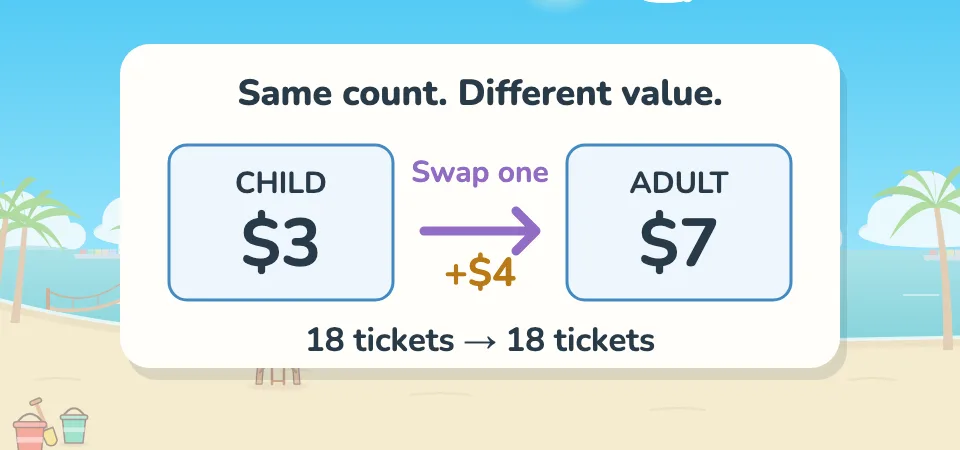
When a problem gives two kinds of item, a total count and a total value, guess and check and the assumption method often use the same underlying change. One item is replaced by the other kind. The number of items stays fixed, while the total value changes by the difference between their individual values.
A trial table lets you see that change one replacement at a time. An assumption lets you calculate several replacements together. To choose between them, first explain what one replacement does. The worked question below follows both routes, then compares a case where a short trial is already enough.
The connection: a replacement changes value, not count
Replacing one item is not adding one item. If one $3 ticket becomes one $7 ticket, there is still one ticket in that place. The money increases by $7 − $3 = $4.
Three pieces of information make this useful: the total number of items, the contribution from each kind, and the required combined contribution. That contribution could be money, mass or points. The method is not justified merely because a question contains two prices.
For every line, keep the fixed total in view. If you increase one kind’s count, decrease the other kind’s count by the same number. Then calculate the combined amount.
Worked question: the same tickets, two routes
A community performance sold 18 tickets. A child ticket cost $3 and an adult ticket cost $7. The tickets brought in $86 altogether.
How many adult tickets were sold?
The unknown is a count of adult tickets. Any proposed answer must satisfy both conditions: 18 tickets altogether and $86 collected. Matching the money while using the wrong number of tickets does not solve the problem.
Route A: guess, check and improve
Try 6 adult tickets. There must then be 18 − 6 = 12 child tickets. Check the money from each kind.
| Adult | Child | Money collected | Check |
|---|---|---|---|
| 6 | 12 | 6 × $7 + 12 × $3 = $78 | $8 too little |
| 7 | 11 | 7 × $7 + 11 × $3 = $82 | $4 too little |
| 8 | 10 | 8 × $7 + 10 × $3 = $86 | Matches |
The first total is too small. An adult ticket is worth more, so replace one child ticket with an adult ticket. The count stays at 18 and the money rises by $4. The next trial follows a reason; it is not another unrelated guess.
Answer: 8 adult tickets.
Route B: assume, then correct
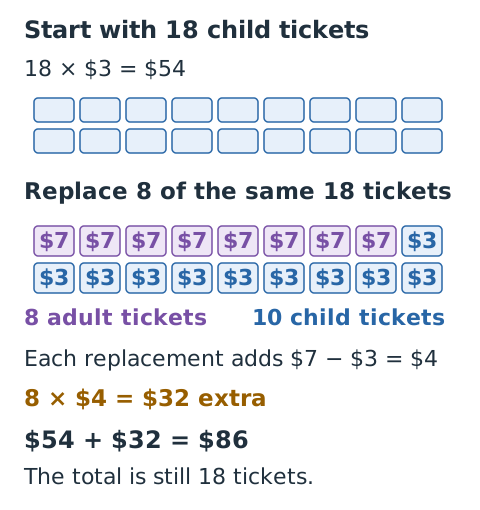
Imagine all 18 tickets were child tickets. This is a convenient starting collection, not a statement that the question says is true.
- Money from 18 child tickets = 18 × $3 = $54
- Extra money needed = $86 − $54 = $32
- Increase for one replacement = $7 − $3 = $4
- Number of replacements = $32 ÷ $4 = 8
Each replacement makes one adult ticket. Therefore, 8 adult tickets were sold. The other 18 − 8 = 10 tickets were child tickets.
The division is meaningful because it asks how many equal $4 increases make the required $32 increase.
Why the routes reach the same answer
The trial table begins with 6 adult tickets. It shows that replacing one cheaper ticket adds $4. Its first total is $8 short, so two replacements are needed. That gives 6 + 2 = 8 adult tickets. You could make that jump directly once you have explained the change.
The assumption begins with 0 adult tickets. It uses the same $4 change, but makes all eight replacements at once. The methods differ in their starting point and how much adjustment is calculated together. They share the fixed count and the value difference.
Check the answer in the original question.
Ticket count = 8 + 10 = 18
Adult ticket money = 8 × $7 = $56
Child ticket money = 10 × $3 = $30
Total money = $56 + $30 = $86
Both conditions match. Checking only “8 × $7 = $56” would leave the child tickets and the required total unchecked.
Choose a start you can explain
A table is useful when you want to see possible combinations or are still learning which direction makes the total rise. An assumption is useful when you can explain a baseline and a fixed change per replacement. A longer count can make repeated one-by-one trials inconvenient, but fewer written lines do not automatically mean clearer reasoning.
Starting with all adult tickets is also valid. The assumed money is 18 × $7 = $126. The excess is $126 − $86 = $40. Each replacement with a child ticket reduces the total by $4, so $40 ÷ $4 = 10 finds the child tickets. The adult count is then 18 − 10 = 8.
Always name what the division finds. The all-cheaper start finds the dearer-item count; the all-dearer start finds the cheaper-item count.
A contrast: one sensible trial can be enough
A club fills 6 envelopes. Each envelope contains either 4 badges or 9 badges. There are 39 badges altogether. How many envelopes contain 9 badges?
A balanced trial gives 3 envelopes of each kind:
- Badges in the smaller packs = 3 × 4 = 12
- Badges in the larger packs = 3 × 9 = 27
- Total badges = 12 + 27 = 39
The first trial satisfies both totals: 3 + 3 = 6 envelopes and 39 badges. There are 3 larger packs. An assumption also works: all smaller packs give 6 × 4 = 24 badges, the shortfall is 39 − 24 = 15, and each replacement adds 9 − 4 = 5. The result is 15 ÷ 5 = 3. Both routes are short here.
Use the price difference, not the full price
For the ticket question, dividing the extra $32 by $7 does not give the number of adult tickets. The adult ticket contributes $7, but the child ticket it replaces had already contributed $3. Each swap adds only $4.
Keeping all 18 child tickets and adding 8 adult tickets changes the count to 26 tickets. Write “replace” beside the adjustment if you need a reminder to keep the count at 18.
Try one independently
A shop sold 20 pens for $61 altogether. Basic pens cost $2 each and refillable pens cost $5 each. How many refillable pens were sold?
Before calculating, state what stays fixed, what one replacement changes, and which count your chosen baseline will find.
Check the reasoning and solution
The count stays at 20. Replacing a basic pen with a refillable pen adds $5 − $2 = $3.
- All-basic cost = 20 × $2 = $40
- Extra money needed = $61 − $40 = $21
- Refillable pens = $21 ÷ $3 = 7
- Basic pens = 20 − 7 = 13
Check: 7 + 13 = 20 pens; 7 × $5 + 13 × $2 = $61. A systematic trial table reaching the same counts is equally valid.
For trial-table foundations, use the existing guess-and-check lesson. For other word-problem relationships, use the More Word Problems study guide. In a new context, identify the count and the contribution per item before choosing either route.
Practise this with your child
 Primary 3 · More Word ProblemsGuess, check and improve
 Primary 4 · Four Operations of Whole NumbersSuppose they were all the same
 Primary 5 · Four Operations of Whole NumbersSuppose they were all the same
Lesson films and practice with worked solutions. Question 1 of every set is free.
Start the free trialKeep learning
 P6
Problem-solving
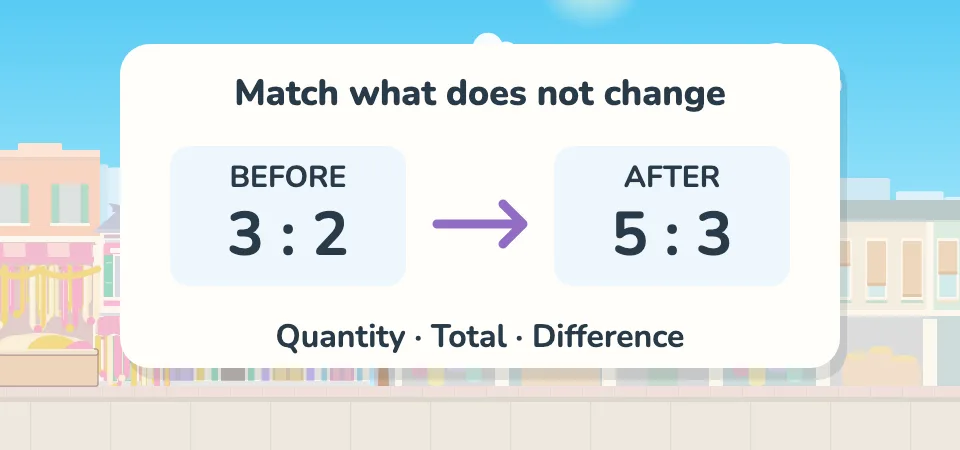
Before-and-After Ratio Problems: How to Tell What Stays the Same
Choose the unchanged quantity, total or difference before calculating.
· 10 min read
 P5–P6
Problem-solving
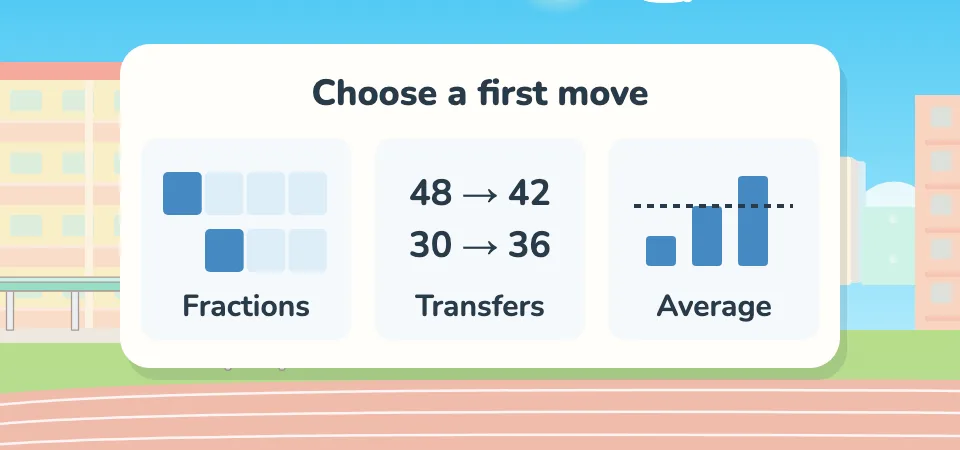
Common PSLE Maths Question Types: How to Recognise the Pattern and Choose a Method
See the relationship in a problem and choose a first move.
· 9 min read
 P4–P6
Problem-solving
Fraction of the Remainder or Fraction of the Total? How to Tell Them Apart
Almost the same words can change which whole you need.
· 6 min read
About these questions
These are original Mathweave questions, written for this article and informed by our research into Singapore primary-school problem structures. They are practice questions, not reproduced school questions or predictions of a future paper.