Why P5 Maths Feels Harder: Connecting the Steps in Questions
Knowing a foundation is useful. Connecting it to the next decision is the new work: find the water used, the reduced price or the perpendicular height.
On this page
P5 maths can feel harder when a familiar skill has to support a newly taught idea. A child may know how to add money, recognise a mixed number or find rectangle area, yet hesitate when the question combines that knowledge with a new operation or shape. The useful question is where the connection stops.
P4 already includes multi-step problem solving. P5 is not simply the year when questions acquire more steps. In the three pairs below, identify the familiar foundation, learn the new P5 idea and name the intermediate quantity that makes the next decision possible. Each worked question is original practice, not a readiness test.
Name what each answer will be used for
Before calculating, finish the sentence “I need ___ so that I can ___.” It turns a list of operations into a plan. After a line of working, say what the result measures: litres used, the price paid for one ticket or a triangle’s perpendicular height.
| Foundation from P4 | New P5 content used here |
|---|---|
| Mixed numbers and improper fractions | Multiplying a mixed number by a whole number; subtracting mixed numbers |
| Calculations with money and decimals | Finding a percentage discount |
| Rectangle area and finding a missing dimension | Triangle base, perpendicular height and area |
These distinctions follow the standard content in the MOE Primary Mathematics syllabus, updated October 2025. A newly introduced P5 idea should be taught before expecting a child to apply it independently.
Pair 1: a mixed number becomes an amount used
P4 foundation: 2¼ means two wholes and one quarter, or 9/4. Converting it correctly is useful, but the conversion alone does not answer a quantity question.
Fill the jugs, then find the remainder
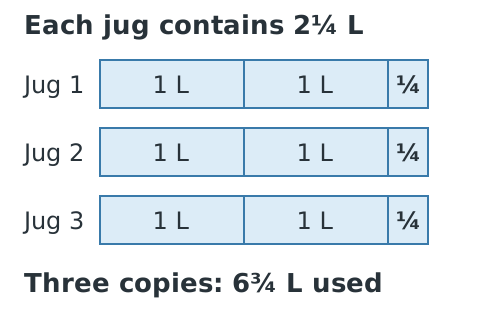
A drink dispenser contains 9½ L of water. Siti fills three jugs with 2¼ L each. How much water remains in the dispenser?
New P5 connection: multiply the complete mixed-number amount by three. The intermediate quantity is the total water used. It is needed before subtracting from the dispenser’s starting amount.
Keep the quantities labelled
- One jug = 2¼ L = 9/4 L.
- Water used = 9/4 × 3 = 27/4 L = 6¾ L.
- Starting water = 9½ L = 38/4 L.
- Water remaining = 38/4 − 27/4 = 11/4 L = 2¾ L.
Check: 6¾ L used + 2¾ L remaining = 9½ L. The amount used is larger than one jug’s amount and smaller than the starting water.
Multiply both parts: writing 2¼ × 3 = 6¼ multiplies only the whole-number part. Three copies of one quarter make three quarters, so the used amount must be 6¾ L.
If the mixed-number representation is unclear, revisit P4 mixed and improper fractions. If that is secure, teach the new operation through P5 multiplying a mixed number by a whole number.
Pair 2: a discount becomes the price paid
P4 foundation: multiply a price by a number of items and add amounts of money. P5 adds percentage reasoning: a discount is a part of the original price.
Three discounted tickets and one fee
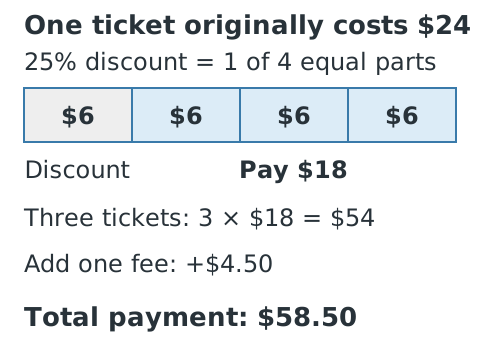
A workshop ticket has an original price of $24. Each ticket has a 25% discount. Bala books three tickets and pays one booking fee of $4.50. The fee is not discounted. How much does he pay altogether?
New P5 connection: first find the discount on one ticket, then its reduced price. That price becomes the amount to multiply by three. The booking fee is a separate quantity added once.
Finish one price before combining costs
- Discount per ticket = 25/100 × $24 = $6.
- Price paid per ticket = $24 − $6 = $18.
- Three tickets cost 3 × $18 = $54.
- Total payment = $54 + $4.50 = $58.50.
Check another way: three original tickets cost $72. Their combined discount is 3 × $6 = $18. Then $72 − $18 + $4.50 = $58.50.
Calculating 25% of the fee as well would answer a different offer. Re-read exactly which items the discount covers. If percentage is the unfamiliar step, use the P5 discount lesson; repeating decimal addition alone will not teach that new relationship.
Pair 3: rectangle measurements identify a triangle’s height
P4 foundation: a 20 cm by 12 cm rectangle has area 20 × 12 = 240 cm². P5 adds triangle area, using a base and its perpendicular height.
Find the area outside the triangle
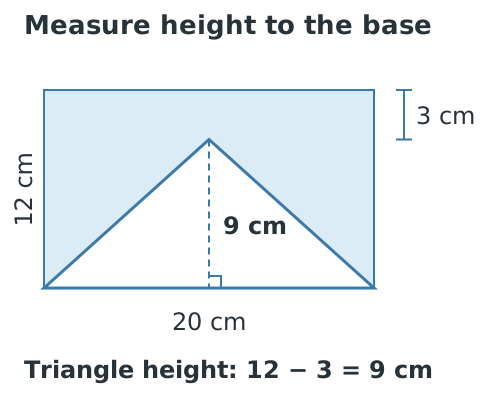
A rectangular display card is 20 cm long and 12 cm high. A triangle inside it uses the entire bottom edge as its base. The triangle’s top vertex is 3 cm below the card’s top edge. Find the area of the card outside the triangle.
New P5 connection: the rectangle’s height is not automatically the triangle’s height. First find the perpendicular distance from the top vertex to the bottom base. That intermediate measurement makes the triangle-area calculation possible.
Find the height, then the area
- Triangle height = 12 − 3 = 9 cm.
- Triangle area = 20 × 9 ÷ 2 = 90 cm².
- Rectangle area = 20 × 12 = 240 cm².
- Area outside the triangle = 240 − 90 = 150 cm².
Check the units: 9 cm is a height; 90 cm² and 150 cm² are areas. The two areas add to the full 240 cm². Using 12 cm as the triangle’s height would put its top vertex on the top edge, contrary to the question.
Use P5 triangle base and height for the new relationship, followed by triangles inside a rectangle for applications.
Try the connections independently
For each question, name the intermediate quantity before calculating.
- A container holds 8¼ L. Four bottles are filled with 1½ L each. How much remains?
- Two tickets have an original price of $36 each and a 25% discount. One $3 booking fee is not discounted. Find the total payment.
- A triangle spans the 16 cm bottom edge of a 10 cm-high rectangle. Its top vertex is 2 cm below the top edge. Find the rectangle’s area outside the triangle.
Show the connections and answers
1. Find the amount used: 1½ × 4 = 6 L. Then 8¼ − 6 = 2¼ L. Check: 6 + 2¼ = 8¼.
2. Find one reduced price: 25% of $36 = $9; $36 − $9 = $27. Two tickets cost $54; adding the single fee gives $57.
3. Find the perpendicular height: 10 − 2 = 8 cm. Triangle area = 16 × 8 ÷ 2 = 64 cm². Rectangle area = 16 × 10 = 160 cm². Outside area = 160 − 64 = 96 cm².
Choose the connection to teach next
If your child stops, ask what the last result represents and what is still needed. Revisit a P4 foundation when that foundation is unclear; teach the relevant P5 idea when it is new. Then use a fresh question to see whether the connection can be made independently. A hesitation is an observation, not a pass-or-fail verdict.
These examples draw on researched primary-school problem structures. The scenarios, data and explanations are original Mathweave practice, with no school endorsement or prediction of a future paper.
Practise this with your child
 Primary 5 · Four Operations of FractionsA mixed number by a whole
 Primary 5 · PercentageDiscount, then GST
 Primary 5 · Area of TriangleBase and height
Lesson films and practice with worked solutions. Question 1 of every set is free.
Start the free trialKeep learning
 P5–P6
Problem-solving
Common PSLE Maths Question Types: How to Recognise the Pattern and Choose a Method
See the relationship in a problem and choose a first move.
· 9 min read
 P3–P6
Problem-solving
Guess and Check or Assumption Method? How to Choose
Two methods, one problem. Understand what each replacement changes.
· 7 min read
About these questions
These are original Mathweave questions, written for this article and informed by our research into Singapore primary-school problem structures. They are practice questions, not reproduced school questions or predictions of a future paper.