Fraction of the Remainder or Fraction of the Total? How to Tell Them Apart
Name the whole at each step. The same fraction can mean a share of what remains or a share of the starting total.
On this page
Before calculating a fraction, name its whole. “One quarter of the remaining beads” means divide the beads still available into four equal parts. “One quarter of the starting beads” means return to the original collection. The fraction looks identical, but the quantity it describes can be different.
This distinction matters when a question gives the amount left, or compares two amounts used, instead of telling you the starting total. We will first change just a few words in a known-total question. Then we will use the same habit to solve an original problem with an unknown starting amount.
Write the whole beside the fraction
After each action, pause and name what remains. Then read the next fraction with its full description. Write “¼ of the remaining 40”, rather than an unlabelled “¼”. The words after the fraction tell you which collection to divide.
Order alone does not settle the meaning. A second action can still use a fraction of the original total. The word “then” tells us when something happens; “of the remainder” or “of the starting total” tells us what the fraction describes.
Same numbers, different wholes
Compare A and B
Hana starts with 60 beads and uses ⅓ of them for a bracelet.
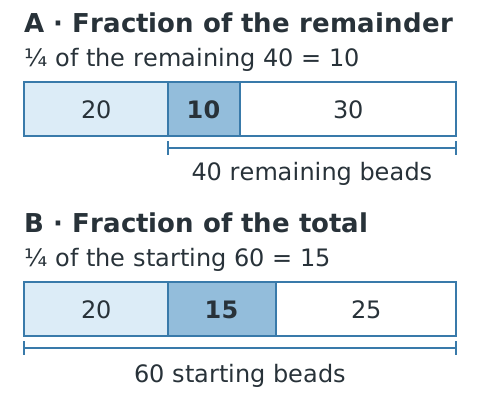
A: She then uses ¼ of the remaining beads for a key ring. How many beads are left?
B: She then uses ¼ of her starting 60 beads for a key ring. How many beads are left?
First find the shared step
- Bracelet beads = 60 ÷ 3 = 20.
- Beads remaining = 60 − 20 = 40.
A: use the remainder
- Key-ring beads = 40 ÷ 4 = 10.
- Beads left = 40 − 10 = 30.
B: use the starting total
- Key-ring beads = 60 ÷ 4 = 15.
- Beads left = 40 − 15 = 25.
The first fraction has the same whole in both stories. Only the second whole changes. In A, the second share is smaller because one quarter is taken from a smaller collection.
Why adding ⅓ and ¼ can mislead
The sum ⅓ + ¼ = 7/12 is correct arithmetic. It describes Story B, where both fractions refer to the starting collection. Using it for Story A silently changes the second whole from 40 to 60. Repair the interpretation before changing the arithmetic.
Check both conditions: A uses 20 + 10 and leaves 30, giving 60 altogether; 10 is one quarter of the remaining 40. B uses 20 + 15 and leaves 25, again giving 60; 15 is one quarter of the starting 60. Adding back checks the total, while the fraction check confirms the correct whole.
An unknown whole: use the difference between two cuts
Original application
A craft group has a roll of wire. It cuts ¼ of the wire for a frame. It then cuts ⅔ of the remaining wire for supports. The supports use 18 cm more wire than the frame.
How long was the wire at first, and how much is left?
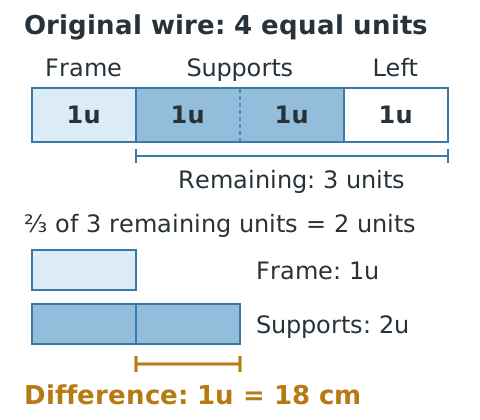
There is no starting length to divide. Represent it with equal units first. Because the first cut uses one quarter, draw the original whole as four equal units. The remainder is three units. Two thirds of that three-unit remainder is two units.
Connect the clue to the model
- Original wire = 4 equal units.
- Frame cut = 1 unit.
- Remainder after the frame = 4 − 1 = 3 units.
- Supports cut = 3 ÷ 3 × 2 = 2 units.
- Difference between the cuts = 2 − 1 = 1 unit.
- 1 unit = 18 cm.
- Original length = 4 × 18 = 72 cm.
- Wire left = 4 − 1 − 2 = 1 unit = 18 cm.
The important intermediate quantity is the three-unit remainder. It connects the first cut to the second. Only after both cuts use the same original units can their difference be compared with 18 cm.
Check with actual lengths: the frame uses 72 ÷ 4 = 18 cm. The remainder is 72 − 18 = 54 cm. The supports use 54 ÷ 3 × 2 = 36 cm. Their extra length is 36 − 18 = 18 cm, as stated, and 18 + 36 + 18 = 72 cm.
What if ⅔ meant the original whole?
Two thirds of the original 72 cm would be 48 cm. The second cut would then exceed the first by 30 cm, which contradicts the given 18 cm. This check tests the wording, not just whether all the pieces add back to the original length.
Try a fresh question independently
A display team has a length of cord. It uses ⅕ for labels, then ½ of the remainder for hanging loops. The loops use 18 cm more cord than the labels.
Find the original length and the length left. Before opening the answer, write which whole the one-half fraction describes.
Show the reasoning and answer
The original cord is five equal units. Labels use one unit, leaving four. The loops use half of those four units, so they use two original units. Their extra length is two units minus one unit: one unit is 18 cm.
- Original length = 5 × 18 = 90 cm.
- Labels = 18 cm.
- Remainder after labels = 90 − 18 = 72 cm.
- Loops = 72 ÷ 2 = 36 cm.
- Cord left = 72 − 36 = 36 cm.
Check: 36 − 18 = 18 cm, and 18 + 36 + 36 = 90 cm.
Take the habit to the next lesson
Ask two questions at each stage: “What is the whole now?” and “Which amount does the next clue describe?” A remainder, one amount used and a difference between amounts used are different clues. Label them on the model before solving.
For the foundation, use P4 fraction of a set. To practise the changing whole, use P4 fraction of the remainder or the P6 remainder lesson. This comparison adds interpretation and a difference clue to those procedural lessons.
Practise this with your child
 Primary 4 · FractionsA fraction of the remainderPrimary 4 · FractionsA fraction of a set
 Primary 6 · FractionsFraction of the remainder
Lesson films and practice with worked solutions. Question 1 of every set is free.
Start the free trialKeep learning
 P6
Problem-solving
Before-and-After Ratio Problems: How to Tell What Stays the Same
Choose the unchanged quantity, total or difference before calculating.
· 10 min read
 P5–P6
Problem-solving
Common PSLE Maths Question Types: How to Recognise the Pattern and Choose a Method
See the relationship in a problem and choose a first move.
· 9 min read
About these questions
These are original Mathweave questions, written for this article and informed by our research into Singapore primary-school problem structures. They are practice questions, not reproduced school questions or predictions of a future paper.