Equal Numbers of Coins, Different Values: Why the Count Ratio Is Not the Money Ratio
Equal coin counts, equal money and equal total counts are different clues. Label the quantity first, then use pairing or replacement to explain the calculation.
On this page
A ratio compares quantities in a stated order. With coins, “the number of 20-cent coins to the number of 50-cent coins” compares counts. “The value of the 20-cent coins to the value of the 50-cent coins” compares money. These ratios need not be equal, even though they describe the same collection.
Start by labelling the quantity in each clue. Equal counts let you form pairs, with one coin of each kind. Equal money gives a different relationship. When two collections have the same total coin count, replacing a cheaper coin with a dearer one can explain their money difference. The examples below separate those three statements.
Counts become values only after using each coin’s denomination
Number of coins × value of each coin = total monetary value. Equal numbers give equal values only when the coins have the same denomination.
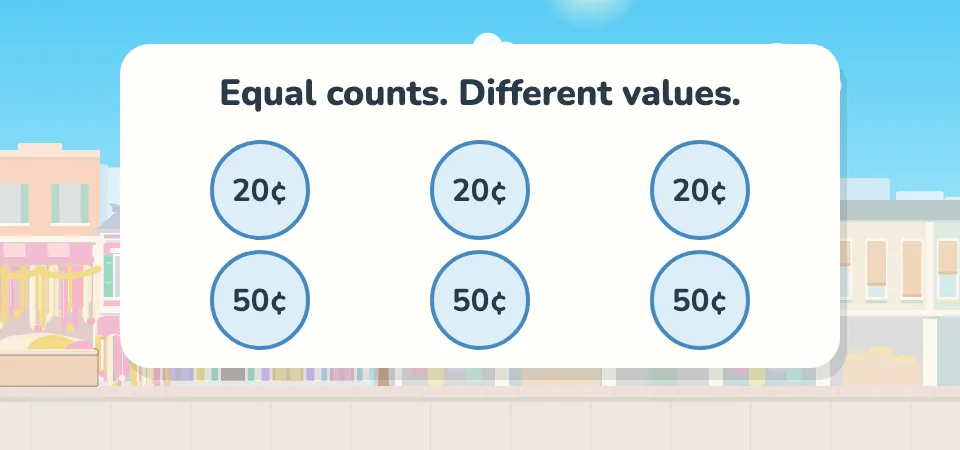
For example, three 20-cent coins are worth 3 × 20¢ = 60¢. Three 50-cent coins are worth 3 × 50¢ = 150¢. The counts are equal; the money amounts are not. In the order 20-cent coins, then 50-cent coins, the count ratio is 3 : 3 = 1 : 1, while the value ratio is 60 : 150 = 2 : 5.
Writing “ratio = 1 : 1” leaves out information the reader needs. Write count ratio or value ratio, and keep the order of the two denominations consistent.
Worked question: equal numbers of two denominations
Bala has an equal number of 20-cent coins and 50-cent coins. Their total value is $5.60.
How many coins does Bala have altogether?
The equality describes the two counts. It does not say that the two kinds contribute equal amounts of money. To use the equality correctly, pair each 20-cent coin with one 50-cent coin. Every coin has a partner because the counts match.
Price one pair, then count the pairs
- Value of one pair = 20¢ + 50¢ = 70¢
- Total value in cents = $5.60 = 560¢
- Number of pairs = 560 ÷ 70 = 8
- Number of coins altogether = 8 × 2 = 16
Answer: 16 coins. There are 8 coins of each denomination.
Check the original conditions
- Value of the 20-cent coins = 8 × 20¢ = 160¢
- Value of the 50-cent coins = 8 × 50¢ = 400¢
- Combined value = 160¢ + 400¢ = 560¢
The counts are equal and the values add to $5.60. Both clues are satisfied.
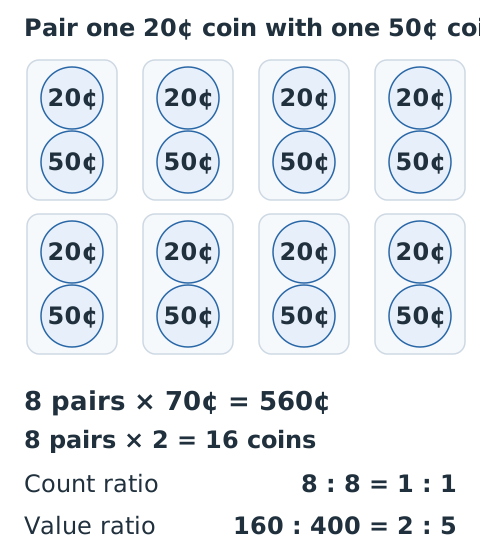
Notice what 560 ÷ 70 counts. The divisor is the value of one pair, so the quotient is the number of pairs. Stopping at 8 would answer “How many 50-cent coins?” but not “How many coins altogether?”
Why the money does not split in the count ratio
“The numbers are equal, so each kind must be worth half of $5.60.” This applies the count ratio 1 : 1 to the money without accounting for the different denominations.
Test the proposed split instead of accepting it:
- Proposed value for each kind = 560¢ ÷ 2 = 280¢
- 20-cent coins in that proposal = 280 ÷ 20 = 14
- 50-cent coins in that proposal = 280 ÷ 50 = 5.6
The proposal gives unequal counts, including a non-whole number of coins. It cannot describe Bala’s collection. This route fails because “equal” was attached to a different quantity.
| What is compared? | 20-cent coins | 50-cent coins | Ratio |
|---|---|---|---|
| Number of coins | 8 | 8 | 1 : 1 |
| Value in cents | 160 | 400 | 2 : 5 |
The value ratio can also be read from one pair: 20 : 50 = 2 : 5. Repeating the pair multiplies both values by the same number, so their ratio remains unchanged.
Contrast: what if the money amounts are equal?
A purse contains $2 worth of 20-cent coins and $2 worth of 50-cent coins. What is the ratio of their numbers, in that order?
This time, equal money is given. Convert each amount to a count separately.
- 20-cent coins = 200¢ ÷ 20¢ = 10
- 50-cent coins = 200¢ ÷ 50¢ = 4
- Count ratio = 10 : 4 = 5 : 2
The value ratio is 1 : 1, but the count ratio is 5 : 2. More cheaper coins are needed to make the same amount of money. Compare this with Bala’s question: the word “equal” is present in both, but it describes a different quantity.
Another comparison: the same total number of coins
Siti and Mei each have 15 coins, all either 20-cent or 50-cent coins. Siti has 9 fifty-cent coins and Mei has 5. How much more money does Siti have?
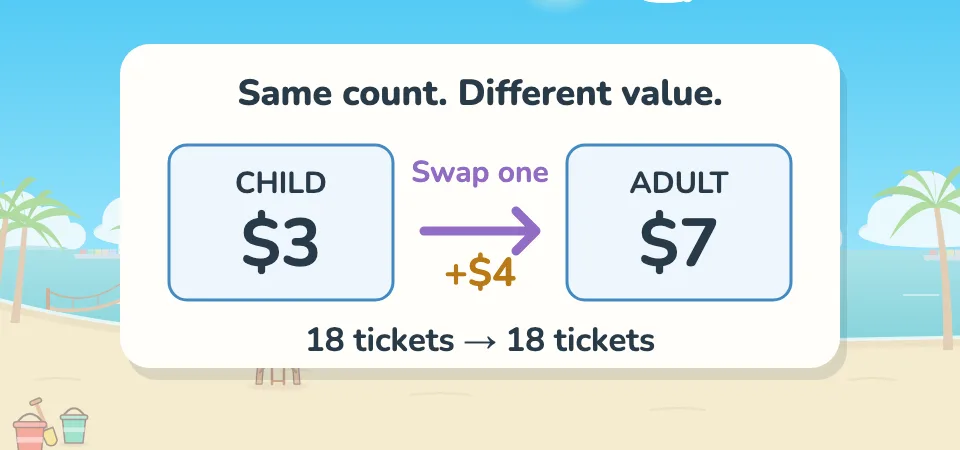
Neither child is said to have equal counts of the two denominations. Their total counts match. Siti’s extra fifty-cent coins must therefore correspond to the same number of missing twenty-cent coins.
- Extra fifty-cent coins = 9 − 5 = 4
- Value increase for each replacement = 50¢ − 20¢ = 30¢
- Difference in money = 4 × 30¢ = 120¢ = $1.20
Siti has $1.20 more. Calculating 4 × 50¢ would ignore the four twenty-cent coins she has fewer of. A replacement accounts for both sides of the comparison.
Direct check: Siti has 15 − 9 = 6 twenty-cent coins, so her value is 9 × 50¢ + 6 × 20¢ = 570¢. Mei has 15 − 5 = 10 twenty-cent coins, so her value is 5 × 50¢ + 10 × 20¢ = 450¢. The difference is 570¢ − 450¢ = 120¢.
Transfer the grouping idea to mass
A provision shop has equal numbers of 2 kg and 5 kg bags of rice. The rice weighs 42 kg altogether. How many bags are there?
The counts are equal, so one bag of each kind forms a complete pair. One pair weighs 2 + 5 = 7 kg. There are 42 ÷ 7 = 6 pairs, containing 6 × 2 = 12 bags.
The count ratio is 6 : 6 = 1 : 1. The mass totals are 6 × 2 = 12 kg and 6 × 5 = 30 kg, giving 12 : 30 = 2 : 5. The reasoning is the same as for coins: the contribution per item converts a count into another quantity.
Try it: decide what is equal
1. Arjun has equal numbers of 10-cent coins and 50-cent coins worth $4.80 altogether. How many coins does he have?
2. Two purses each contain 18 coins, all either 10-cent or 50-cent coins. One purse has 3 more fifty-cent coins than the other. What is the difference in their values?
Check the reasoning and answers
1. Equal denomination counts allow pairs. Each pair is worth 10¢ + 50¢ = 60¢. Number of pairs = 480 ÷ 60 = 8. Number of coins = 8 × 2 = 16. Check: 8 × 10¢ + 8 × 50¢ = 480¢.
2. Equal total counts allow replacement comparison. The extra fifty-cent coins replace 3 ten-cent coins. Increase per replacement = 50¢ − 10¢ = 40¢. Value difference = 3 × 40¢ = 120¢ = $1.20.
For the underlying notation, revisit writing a ratio. For grouping with different contributions, use the price of a repeated set. In each new question, label the count, the contribution per item and the total before choosing which ratio to use.
Practise this with your child
 Primary 6 · RatioThe price of a repeated setPrimary 6 · RatioWhat a ratio says
Lesson films and practice with worked solutions. Question 1 of every set is free.
Start the free trialKeep learning
 P6
Problem-solving
Before-and-After Ratio Problems: How to Tell What Stays the Same
Choose the unchanged quantity, total or difference before calculating.
· 10 min read
 P5–P6
Problem-solving
Common PSLE Maths Question Types: How to Recognise the Pattern and Choose a Method
See the relationship in a problem and choose a first move.
· 9 min read
 P3–P6
Problem-solving
Guess and Check or Assumption Method? How to Choose
Two methods, one problem. Understand what each replacement changes.
· 7 min read
About these questions
These are original Mathweave questions, written for this article and informed by our research into Singapore primary-school problem structures. They are practice questions, not reproduced school questions or predictions of a future paper.